Sunday, May 09, 2010

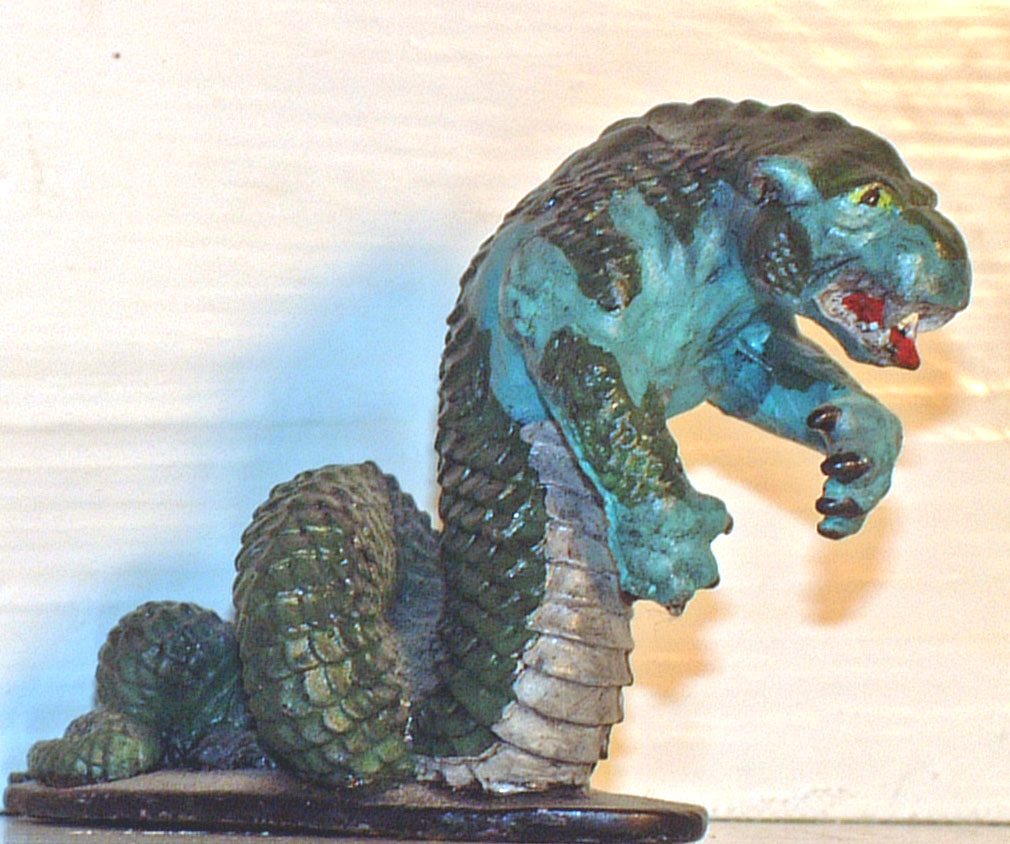
Hellstinger Scorpion

CLIMATE/TERRAIN: Native to Third and Fourth layers of the Nine Hells, where it is common, but can be found in desert ruins on Prime Material
FREQUENCY: Very Rare
ORGANIZATION: Solitary
ACTIVITY CYCLE: Any
DIET: Carnivore
INTELLIGENCE: Animal (1)
TREASURE: Nil or incidental in lair
ALIGNMENT: Neutral Evil
NO. APPEARING: 1-35 (1)
ARMOR CLASS: 6
MOVEMENT: 18
HIT DICE: 13
THAC0: 7
NO. OF ATTACKS: 3
DAMAGE/ATTACK: 2d6+4/2d6+4/1d8+4 (+fire damage from claw and venom)
SPECIAL ATTACKS: Hellish Sting, Fire Claw
SPECIAL DEFENSES: Immune to poison and heat/fire damage
MAGIC RESISTANCE: 15%
SIZE: L
MORALE: Steady (12)
XP VALUE: 8,000

Hellstinger scorpions are vicious predators that are native to the third and fourth layers of the Nine Hells, however at some point it is believed that an evil priest gated in hundreds of these creatures as part of an arcane ritual and the hellstingers flourished in Toril’s deserts, especially Anauroch. They look and behave very similarly to giant scorpions, but are immediately recognizable as extra-planar in origin by their searing heat radiating from their red-hot claws.

The hellstinger scorpion has a red carapace, legs and claws. The segmented tail is orange, with a vicious stinger on the end. There is a bitter smell associated with the scorpion, which probably comes from the venom. They make an unnerving scrabbling sound as they travel across rocky terrain.

Combat: The hellfire scorpion is 95% likely to attack any creature that approaches. Scorpions of any variety do not use visual or aural senses to detect prey. Instead they use the vibrations of the sand underneath them. Small sensors on their legs pick up and measure the strength of the vibrations, using the minute differences in the vibrations detected by each leg to locate the prey. Hence, the scorpion can detect your presence even if it isn’t looking at you or you are invisible. When it determines the location and distance of the prey, it calculates when the prey is within sufficient range to attack in a single rushed charge with pincers extended. It will remain motionless until this attack, and players must make a roll for surprise when it does. The scorpion can sense these vibrations up to a distance of 3 times that of its length. (Giant: 9’; Monstrous: 45’) Scorpions have the same limitations on attacking and moving that characters and NPCs do, in that they can not move more than 1/2 of their max movement in one round and still attack. Tunneling under a scorpion also does not protect from detection, unless the tunnel is so deep it is beyond the range of detectable vibration. Therefore, the scorpion is almost impossible to surprise by any attacker who travels on or below the ground.

An injured scorpion which is missing legs will suffer a 10% penalty on its detection roll for each leg that it is missing or crippled. If several adjacent legs are missing or damaged, the scorpion will not be able to detect motion in that quadrant.

The creature has a hellishly hard, chitinous carapace that gives it Armor Class –4. This monster attacks by grabbing prey with its two huge pincers, inflicting 2d6 points of damage each +4 points of heat damage, while it lashes forward with its tail to sting. Thus, it can fight three opponents at once. If a hellfire scorpion manages to grab a victim in a pincer, it will automatically inflict 2d6+4 points of damage each round until it releases the victim. If the sting is employed against an un-trapped victim, an attack roll is required for a successful attack, but a trapped character is automatically struck by any sting attack directed at him with no attack roll required. The victim has but one chance to escape. If he can make his bend bars/lift gates roll, he will escape the claw. However, this can be the character's only action that round and it can be tried only once per combat. If the victim escapes, however, it will automatically be stung without chance to miss by the reactive sting of the hellfire scorpion.

The sting inflicts 1d8 points of damage from the poison +4 points of heat damage and the victim must save versus poison or permanently lose one point of Strength. Neutralize Poison will stop the loss of strength and damage, and a point of Strength will be returned each time a full flask of Elixer of Health is imbibed.

Note that this scorpion type is immune to their own poison.

If a hellfire scorpion is reduced to 1 or 2 hit points, it will go into a stinging frenzy, stinging everything in sight, gaining two attempts to hit per round with only the tail. Slain creatures are dragged to the scorpion's burrow to be eaten.

Habitat/Society: Hellstinger scorpions live in underground burrows and ruins found in dry, arid climates. If found in a dungeon, or other subterranean location, the uncharacteristic dryness of the air created by the heat of the creature will be an early clue that something is amiss. Hence, they tend to favor climates where their natural ability to dehumidify does not alert potential prey to avoid them.

Each lair may (20%) have 5d4 scorpion eggs. These beasts eat any living creature that is unfortunate enough to stray too close to their lair. Any treasure found comes from the bodies of human or demi-human victims that have been dragged here to be consumed. Armor is rarely found intact, since the scorpion will surely have used its pincers to cut up its prey.

Ecology: These bizarre insects contribute little to any ecosystem. They themselves are seldom prey for other creatures and so where there is one, there are likely many.

Labels: ,

Saturday, May 08, 2010

Reek (adapted from Star Wars)

CLIMATE/TERRAIN: Underdark
FREQUENCY: Uncommon
ORGANIZATION: Herd
ACTIVITY CYCLE: Any
DIET: Omnivore
INTELLIGENCE: Animal (2-4)
TREASURE: Nil
ALIGNMENT: Chaotic Neutral
NO. APPEARING: 1-6 (3)
ARMOR CLASS: 5
MOVEMENT: 12
HIT DICE: 10
THAC0: 11
NO. OF ATTACKS: 1
DAMAGE/ATTACK: 1d10 (horn), 1d8 (bite), 1d6 (kick)
SPECIAL ATTACKS: Charge and trample
SPECIAL DEFENSES: Nil
MAGIC RESISTANCE: Nil
SIZE: H
MORALE: 8-10
XP VALUE: 1,400

These immense creatures of the Underdark are similar to the surface rhino, but larger and more aggressive. They are primarily herbivores, but plant life in the depths of the Underdark is not abundant. They have adapted, however, to eat whatever food is available and are known to eat meat when no other food is at hand. They like to find mud pools near subterranean water sources, and will wallow for hours. Their horns, though fierce, are not primarily weapons, but are used to knock away stone and dirt to get at insects or plant life in hard to get crannies.

The meat of a Reek is not considered a delicacy, but is nourishing and one can acquire a taste for it, especially if there is little else available. The meat from a single Reek can feed a large number of creatures but they are difficult to capture or domesticate.

Labels: ,

Worm, Runespiral

CLIMATE/TERRAIN: Underdark
FREQUENCY: Very Rare
ORGANIZATION: Hive
ACTIVITY CYCLE: Any
DIET: Carnivore
INTELLIGENCE: High (14)
TREASURE: Incidental
ALIGNMENT: Neutral Evil
NO. APPEARING: 1-25 (5)
ARMOR CLASS: 4
MOVEMENT: 9
HIT DICE: 9
THAC0: 11
NO. OF ATTACKS: 6
DAMAGE/ATTACK: 1d4 x6
SPECIAL ATTACKS: Hive scream
SPECIAL DEFENSES: Confusion
MAGIC RESISTANCE: 50%
SIZE: M
MORALE: Steady (12)
XP VALUE: 6,000

These strange creatures of the deep Underdark live in colonies and seem to have a hive mind, meaning that they are telepathically linked and what one sees, all see. They communicate via this mental link, and so have no use for language. They seem to be able to understand languages of other races, but either do not have the ability to communicate their thoughts to other species or simply have no interest in doing so. Their name comes from their “shell” covering the top or back portion of the creature. It is not really a shell at all, but a semi-transparent sack filled with some sort of fluid that from a distance appears to be a constantly changing series of runes. In reality, they are not runes at all, but some sort of bodily fluids of different colors that are constantly shifting. Mammals find the changing patterns impossible to ignore, and if within 10 feet of the creatures any mammalian creature must save vs. spells or be transfixed for 1d4 rounds. At the end of the effect, another save vs. spell must be made to avoid one of 4 terrible mental effects:
Confusion, as per the spell cast by a 9th level wizard
Sleep as cast by a 9th level wizard
Fear as per the spell cause fear cast by a 9th level wizard
Permanent loss of 1d4 points of Intelligence

Obviously, the effects are negated if there is no light by which to see the runes, or if blinded. Monstrologists believe this is an added protection against creatures in the Underdark who use artificial or natural light. The Runespiral Worm has excellent night vision and are unaffected by their own runes.

Each Runespiral Worm has 6 bladelike appendages on their upper body near the head. These are as deadly as a fighter with 6 shortswords that can be used in a single round. Thus, the creature is as able to defend from the front as they are defended from behind.

Their other defense is a screeching howl which can be used to drown out all other sound (rendering spell casting as ineffective as a globe of silence) and causing actual physical pain to the ears. When one howls, any other worm within 125 feet will also take up the howl, thereby increasing the noise and the damage it causes. No sound but the screeching can be heard within 125 feet of the creatures howling, and those within range suffer deafness for 1d6 rounds per screeching worm, and 1d4 points of damage each round the howling continues. Screeching will continue for 1d12 rounds from the first screech. This defense can only be used once per day.

Labels: ,

Crypt Worm (Ghoul Worm)

CLIMATE/TERRAIN: Any burial ground
FREQUENCY: Very Rare
ORGANIZATION: Solitary
ACTIVITY CYCLE: Any
DIET: Carrion
INTELLIGENCE: Low (3)
TREASURE: Nil
ALIGNMENT: Neutral
NO. APPEARING: 1-2 (4)
ARMOR CLASS: 6
MOVEMENT: 8, Br 4
HIT DICE: 3
THAC0: 17
NO. OF ATTACKS: 2
DAMAGE/ATTACK: 1d6+2 (bite)
SPECIAL ATTACKS: Paralysis
SPECIAL DEFENSES: Stenchcloud
MAGIC RESISTANCE: Nil
SIZE: L
MORALE: Elite (18)
XP VALUE: 420


This horrible worm is blind, but possesses an amazing sense of smell that allows it to detect dead flesh from hundreds of feet away. The creature has a stench cloud defense mechanism, which erupts when it first takes damage, causing an effect identical to the spell of the same name as though cast at 9th level. The creature can only emit a stench cloud once per day.

It also is coated in a slime which causes paralysis, similar to the ghoul touch spell. The creature has two bite attacks per round, but need only roll to hit once. If one hits, both attacks hit, because the mouths are so close together.

Labels: ,

Monday, April 09, 2007

New Monster: Flaming Flail

I use a figure based campaign, and a lot of the 3E monster minis are cool, but I have no desire to use them as they are depicted in 3E, so I make them into entirely new monsters with 2E stats. A good example is the Blood Golem of Hextor. I think it is kind of a stupid monster as described in the 3E Fiend Folio, so I'm making it an automaton in my game.

Here are the stats. It is basically a flame throwing tank.

Automaton: Flaming Flail

CLIMATE/TERRAIN: Any land or subterranean
FREQUENCY: Very Rare
ORGANIZATION: Solitary
ACTIVITY CYCLE: Any
DIET: Nil
INTELLIGENCE: Low (5-7)
TREASURE: Nil
ALIGNMENT: Neutral
NO. APPEARING: 1-5 (1)
ARMOR CLASS: 2
MOVEMENT: 8
HIT DICE: 10
THAC0: 11
NO. OF ATTACKS: 3
DAMAGE/ATTACK: 1d10+6/1d10+6/ 5d6 (oil of fiery burning)
SPECIAL ATTACKS: See below
SPECIAL DEFENSES: See Below
MAGIC RESISTANCE: 100% to mind affecting
SIZE: G
MORALE: Fearless (20)
XP VALUE: 2,000

The flaming flail is a construct designed to cause havoc on the battlefield with its combination attacks of whirling flails and gouts of oil of fiery burning that spew from its mouth like a flame thrower.

Combat: Attacks by the flails are fairly straight forward, however the twin tanks containing large amounts of oil of fiery burning do require some explanation. When the oil is exposed to air , it immediately bursts into flame, inflicting 5d6 points of fire damage to any creature directly exposed to the substance (save vs. spell for half damage). Because it begins burning as soon as it comes out of the mouth of the automaton, it doesn’t get far and this damage is done only to those within 5 feet of the creature. Each tank holds 25 charges of the oil.

As with all automatons, the flaming flail is immune to all mind affecting and fear based attacks.

Labels: ,

Saturday, December 30, 2006

New Monster: Nightling

Nightling
CLIMATE/TERRAIN: Lower Planes, Plane of Shadow
FREQUENCY: Very rare
ORGANIZATION: Solitary or small group
ACTIVITY CYCLE: Night
DIET: Special
INTELLIGENCE: Genius (18-19)
TREASURE: Nil
ALIGNMENT: Chaotic Evil
NO. APPEARING: 1-3 (3)
ARMOR CLASS: 9, 5, or 1
MOVEMENT: 12, Fl 30 (B)
HIT DICE: 7 +3 (base)
THAC0: 13
NO. OF ATTACKS: 3
DAMAGE/ATTACK: 1d4/ 1d4 / 1d6
SPECIAL ATTACKS: See below
SPECIAL DEFENSES: See below
MAGIC RESISTANCE: See below
SIZE: M (6’ tall)
MORALE: Champion (15-16)
XP VALUE: 5,000 (+1,000 per additional HD over 7)

Nightlings are a something like cross between a shadow fiend and a succubus, and for all that can be proven, that is what they actually are. Though very beautiful, they are a dark and dangerous creature from the most dreaded of the lower planes. Lurking in regions of darkness, they attack not only to satisfy a desire to do evil, but also to gain power by siphoning off the life energy of its victims.

The nightling looks like a tall, slender humanoid female with large bat-like wings. These creatures have nasty claws on both their hands and feet, which are always exposed as the nightling clothes itself in nothing but darkness.

Nightlings speak Common and the language of fiends of the lower planes.

Combat: The primary interest of nightlings is in the stealing of life force from their victims, and therefore they will attempt whenever possible to approach when their prey is deep in slumber. Like shadows, these horrors are 90% undetectable when they move through dimly lit or shadowy conditions.

If they are able to approach their victim undetected while he sleeps (95% chance in darkness, 45% in dim light, 20% in bright light), the nightling positions its mouth about an inch from the sleeper’s own mouth and nose. For 1d3 rounds it silently breathes in the breath of its victim, and its victim breathes in the exhalations of the nightling. At the end of this process the victim is paralyzed for 1d4 hours, unless a save is made vs. breath weapon, in which case the paralysis effect is negated. The nightling then embraces the victim, which instantly awakens him. If paralyzed, he can neither resist nor call out for help--and is completely aware of what is happening. The embrace of a nightling will energy drain their victim, causing him to lose one life level per round for 1d4 rounds. Each life level drained from the victim adds a Hit Die to the nightling who has drained him.

The nightlings are also adept at physical combat, though they shun it. When they attack those who have not spotted them, they always attain surprise. Each round the monster is able to strike with two of its wicked claws (inflicting 1d4 points of damage each) and its horrible bite (inflicting 1d6 points or damage.)

Once engaged in combat, the power of the creature depends upon the lighting in the area of battle. In brightly lit areas (open sunlight, a continual light spell, and such), the nightling is greatly weakened. Here, its Armor Class is 9 and all attacks that strike it do double damage. Because of this, nightlings will normally flee from opponents in bright light.

In dimmer lighting, that created by a torch, lantern, or light spell, the nightling is somewhat better off. Here, it has an armor class of 5, though it still suffers normal damage from attacks. When it strikes in these conditions, however, it gains a +1 on its attack rolls.

In darkness, anything up to candle or moonlight, the creature is at its deadliest. Here, it gains a +2 on all attack rolls and is Armor Class 1. Further, all damage done to the creature is halved.

Regardless of the lighting around it, the nightling is immune to all damage from fire, cold, and electricity (whether magical or mundane in nature.) A light spell cast directly at the creature inflicts 1d6 points per level of the caster, although this damage may be reduced (or enhanced) by the lighting in the area.

Whenever the nightling gains surprise, it will spring onto its victim. Because of the small wings on its back, it can leap up to 30 feet and strike with four claws (each doing 1d4 points of damage.) When it leaps, it cannot employ its bite attack.

Once per day, the nightling may cast a darkness, 15' radius spell or subject all persons within a 30 foot area to a fear spell. Once per week, it can cast a magic jar spell at a single target (provided that it has a suitable receptacle for the victim at hand.) If the victim of the magic jar attack makes his saving throw, however, the nightling is stunned for 1d3 rounds during which time it cannot act.

Nightlings can be turned by clerics as if they were "special" creatures on the undead turning chart.

Habitat/Society: The nightling is called into the Prime Material Plane by the use of magical gate spells and similar incantations.

Ecology: The nightling has no role in the ecology of the Prime Material Plane.

NOTE: I thought these DC Heroclix figures for Fury would make an interesting D&D monster. The above description is what I came up with, drawing on the descriptions for both the Shadowfiend (Ravenloft Compendium) and the Succubus (MC8). No copyright or trademark infringement intended.

Labels: ,

Tuesday, December 26, 2006

New Monster: The Catile

I'm never going to post stat sheets for existing monsters, but I thought it might be fun to share some of the original monsters I've created for my 2E game from figures that didn't have corresponding TSR or WOTC references. This miniature is stamped Ral Partha 1983.

Catile
CLIMATE/TERRAIN:
Jungles, tropical forests, swamps
FREQUENCY: Uncommon
ORGANIZATION: Solitary
ACTIVITY CYCLE: Any
DIET: Carnivore
INTELLIGENCE: Low (5-7)
TREASURE: F
ALIGNMENT: Neutral Evil
NO. APPEARING: 1-4 (1)
ARMOR CLASS: 6
MOVEMENT: 12
HIT DICE: 12
THAC0: 9
NO. OF ATTACKS: 3
DAMAGE/ATTACK: 1d4/1d4/1d6
SPECIAL ATTACKS: See below
SPECIAL DEFENSES: Chameleon ability
MAGIC RESISTANCE: Nil
SIZE: L
MORALE: Steady (12)
XP VALUE: 3,000

The catile is a horrific combination of snake-like reptile and great cat. The feline portions of the beast are covered in a strange blue-green fur while the reptilian portion of its body possesses the ability to take on the coloration of the flora in which it hides, similar to a chameleon. This renders the creature effectively invisible when hiding. When so concealed, the creature surprises victims automatically, adding + 3 to its attack roll for the initial surprise attack.

I never got much more detailed than that back in the 80's. If I end up running this monster in my new campaign I might flesh it out a bit more and do a detailed MC page for it. If anyone out there would like to come up with the Monstrous Compendium page info for me, just post it in the comments and if I like it, I'll use it.

Labels: ,

Friday, November 10, 2006

Sand Dragon

For years and years I'd used this dragon miniature (possibly another in the Sculptor's Row series by Ral Partha?) as a representation for a Deep Dragon.

WOTC came out with their own Deep Dragon mini in Underdark (#52 Large Deep Dragon--see sidebar image) though, and since they set the standard appearance for trademark, my dragon figure had to become something else.

I don't know why I painted it this ocher color, but I'm sure I painted it before I decided to make it a Deep Dragon. I think it was something about the dragon being perched on rocks that reminded me of the illustration of a deep dragon in the TSR materials. I couldn't find any 2E compendium sheets that looked like this dragon, but the color reminded me of sand, so I have decided to invent a desert dwelling dragon to bedevil the sand giants. Stats are very similar to the compendium sheet for the Sapphire Dragon (since I just copied the page), with a few changes.

Most notably the breath weapon:

A sand dragon's breath weapon is a cone of incredibly arid and dehydrating air, 75' long, 5' wide at the dragon's mouth, and 25' wide at the base. Creatures caught by the blast may save vs. breath weapon for half damage from dehydration caused by the drying air. Victims who reach 0 HP are considered completely dehydrated and are dead. Victims killed in this fashion are unable to be raised from the dead and are completely mummified. Sand dragons will not eat food which has not been dried in this fashion. A sand dragon casts spells and uses its magical abilities at 7th level, plus its combat modifier.

It also has a little barb on its tail, so I've endowed it with a poisonous sting like a corpion's.

PS: As to the previous post, I'm very pleased with the electrifying showing the Blue Dragons had earlier this week.

Labels: ,

Monday, November 06, 2006

10-461 Fearless Frost Dragon


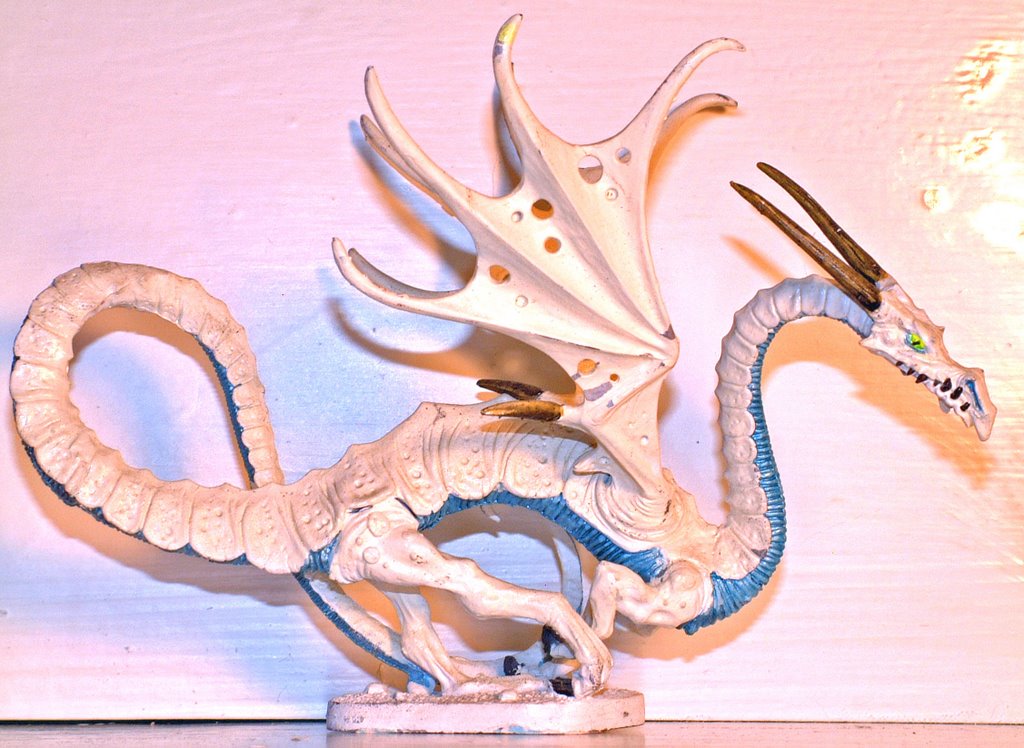
This was a series, I think by Ral Partha, called Sculptors Row. It is my favorite White Dragon that I have, I doubt that the WOTC White Dragons are going to ever make me feel differently, though the white dragon head on the Aspect of Tiamat does look very similar to the artwork of the 2E compendium sheet for White Dragon.

I read on one of the various 3E message boards I sometimes visit because a google search for something has brought up these 3E punks complaining about how stupid and awful 2E is and I need something to distract me momentarily from my very bad habit of reading conservative political blogs to get my blood pressure rising. Not that high blood pressure over D&D is any better than high blood pressure over politics, but at least it is easier to dismiss as fantasy than RedState.com...anyway, I digress.

I was reading one of these message boards and they were talking about how the recent trend by WOTC to standardize dragons in order to more effetively enforce copyright and trademarks for specific dragon characteristics was having a negative effect on the variety of possible looks for dragons.

I'm a little torn. As you know, I am committed to finding figures that look like TSR artwork (and thankfully, WOTC figs often bear a passing resemblence), but I agree that it would suck if I felt like the above dragon wasn't really a White Dragon because it had two horns and not one bony fin. I also don't want to feel like I need to sell my black dragon from the Krynn box just because its horns are straight and not curving down in such a way as to pose real problems in eating like the WOTC official Black Dragon does. So, I think in my world there will be a little more variation than WOTC would like...and the main identifying characteristic of a dragon will be its color, rather than its trademarked physical features. If a dragon is white, no matter what else it looks like, it is probably a fair bet that it will hit you with a cone of cold rather than a gout of acid.

Maybe you want me to say, well, white dragons look like WOTC say they do, but what you have here is clearly a Frost Dragon, like the box says it is.

Fine. Call it a Frost Dragon, then, but the stats, background, and ecology of Frost Dragons and White Dragons are going to be exactly the same and I'm not doing a seperate sheet in the compendium for it! So there.

I'm going to scan this compendium sheet now and then go up and re-read Life is a Dream, since I'm teaching it to a dramatic lit/theatre history class in about 4 hours.

Labels: , ,